I recently launched Art of the Problem on Kickstarter.com which is an interesting new crowd sourced funding network for creative projects. A total of 88 people pledged to the project and my $4,000 funding goal was reached. As of today (May 13th 2011) production work has commenced on the pilot episode titled ‘Gambling with Secrets’, soon to be available at www.youtube.com/artoftheproblem.
Art of the Problem – Kickstarter funding successful
Posted in Research and Projects, Video / Theatre with tags art of the problem, computer science, cryptography, educational web series, kickstarter, Shannon on April 1, 2011 by Brit CruiseReal Time Control of Emotional Affect in Algorithmic Music
Posted in Random Stuff, Research and Projects with tags "Computer Music", additive synthesis, algorithmic music composition, algorithmic music for video games, Algorithmic music synthesis, Amilcar Cardoso, Antonio Oliveira, aritifical orchestra, Artificial Intelligence, circumplex model of emotion, computer science, dimensions of emotion, douglas cope, Douglas Eck, emily howell, emotion control in generative models, Expressive performance algorithms, generative models of music, Generative Music, low-level music features, mood control, music affect, music and emotions, music and mood, music classification, sprecturm, subtractive synthesis, timbre, video game music on May 31, 2010 by Brit Cruise
DEMO OF DYNAMIC INSTRUMENTATION:
Introduction
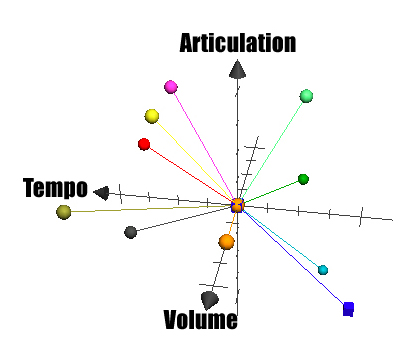
The purpose of this post is to propose a solution to the following future research directions offered in two papers on the Algorithmic Music Evolution Engine (AMEE) “A Flexible Music Composition Engine” and “Real-Time Emotional Adaptation in Automated Composition”, recently developed at UWO (Hoeberechts, Demopoulos, Katchabaw 2007)[10][11]. I’ve divided up the problems into two high level categories A and B: Continue reading
Robot 1.2 – new Direction
Posted in Research and Projects with tags "Computer Music", electrical engineering, microcontroller, rhythmic algorithms, robotic percussion, robotics on April 24, 2010 by Brit CruiseLast year, the development of Robot 1.1 was an experiment in electrical Engineering and the Psychology (In terms of
rhythmic human-computer interaction). It is a hardware interface which interprets ambient sound as structured pulses (using low pass filter, peak detector and tempo filter circuits) that are fed into a microcontroller which controls a solenoid powered drum stick (see previous post for video):

I have been pondering both applications and new directions for this technology. One of the main questions I kept running into while working on this project, was the question of response time. In order for a rhythmic system to be interactive, it must operate in real time. The hardware aspects of Robot 1.1 were very effective at generating a real time response. Although, the functionality was limited: Continue reading
It’s ALIVE – Robotic Drummer Interacts With Humans!
Posted in Random Stuff with tags AI, Artificial Intelligence, autonomous drummer, Beat induction, Brit Cruise, computer science, Drum, Interactive Robotics, Mike Vance, Music, Musical robot, percussion system, Robotic Drummer, university of western ontario on March 15, 2010 by Brit CruiseAfter months of design and construction between myself & Mike Vance, we’ve designed and created a machine we never thought possible…..A robotic musician which can interact with human players. Our Intelligent Robotic Percussion system was presented at the Engineering Design Presentations at the NRC research facility this past Friday. Our system had never been operational until 9 hours before the presentation, we were a hair’s breadth away and ready to finally give up….
Beat Induction and Analysis with Robotic Percussive Improvisation Systems
Posted in Research and Projects with tags Beat induction, computer science, improvisation, rhythm recognition, robotic percussion on November 11, 2009 by Brit CruiseThis Report will explore the past and current research into the areas of Beat Induction, Rhythm Recognition and percussive improvisation.First we must ask, why? In terms of current robotic systems, most focus simply on sound production (Mechanically reproducing a set of static instructions) and rarely address perceptual aspects of musicianship, such as listening, analysis, improvisation and interaction with human input. There has been some breakthrough work done on improvisation and robotic percussion in the last few years which will be explored. First we will introduce the problem of beat induction and the varying methods by which it can be achieved. We will then attempt to clearly understand how this problem will be applied to our robotic system. Furthermore we will show how we can use state-of-the-art research into similar robotic systems as a guide and stepping stone for our project.
Time & The River
Posted in Video / Theatre with tags Borges, Brit Cruise, eclipse, infinity, jorge, London Canadian Film Festival, luis, lunar, total, UWO Film Festival on September 22, 2009 by Brit Cruise
Exploring Music Spaces – Computer Science Research Journal
Posted in Random Stuff, Research and Projects with tags Algorithmic music, Artificial Neural Networks, Borges, Brian Eno, computer science, Generative Music, Genetic Algorithms, Markov Chain, Music, Neural Networks, Support Vector Machines, Swarm Music on September 15, 2009 by Brit Cruise
A few years ago when I was introduced to Borges I was moved by the idea of a complete library. His short story, Library of Babel, most importantly reminded me of the difference between the infinite and the very very large. Continue reading
The Production of On The Menu
Posted in Video / Theatre with tags acting, behind the scenes, Grand Theatre, LOAF, London One Act, London One Act Festival, lyndsay simmons, making of, Theatre, Theatre tech on April 19, 2009 by Brit CruiseLast month Lyndsay’s play On The Menu was accepted into the London One Act Festival at the Grand Theater. So, out of the blue Lyndsay was responsible for casting, producing and directing a play within 3 weeks. This was a huge commitment, much more so than a normal hobby would consume….She kept up a journal of the process on her website.
Below are some photos of last weeks work:


Rehearsals were moved to our living room, where I set up a mock stage. This helped assist with staging since we had very limited time – and only a handful of rehearsals.
Randomness of coin flip vs human guess
Posted in Uncategorized with tags 50/50, coin flip, frequency stability, human guess, probability, randomness, randomness of coin, statistics on November 29, 2008 by Brit CruiseYou may have heard that humans are not “good” at generating randomness. This video explains why a coin flip is very different from a guess….
Understanding the Probability of Dice, Visually
Posted in Video / Theatre with tags calculate odds, cheat at dice, craps, odds of dice, probability space, probability theory, randomness on August 26, 2008 by Brit CruiseJust finished an animation segment for Art of the Problem which helps explain the concept of probability space and how it applies to dice. Great for anyone who hasn’t thought/heard of a probability space:
Jazz Music
Posted in Research and Projects, Video / Theatre with tags brad mehldau, jazz, liam murray, moog, moog theremin, piano, theremin on August 24, 2008 by Brit CruiseI Spent some time this summer aside from school & work playing more improvisational jazz piano. I enjoy jazz because once you can place your mind in the time & space of jazz you can experience the thrill of it, even as a beginner (like me). This thrill being a dual sense of unknowing and knowing: The understanding of where you can go with musical statements, while being unsure of the actual execution or path to take. All the while being aware of some passing feeling that undulates with the music. Lately I’ve been a huge fan of Brad Mehldau – performance video.
I had a jam recorded with some friends in Waterloo last week – it was rough around the edges, but great a space to play in.
Also, I’ve acquired some old studio lights this summer and I experimented with them by making a jazz video. A guy named Luke brought over his Moog Theremin to try out as well – it’s a crazy device:
Intelligent Robotic Percussion System (Drumming Robot)
Posted in Research and Projects with tags Artificial Intelligence, cognitive, computer science, drumming robot, Duncan Storey, Engineering, engineering drum, mechatronics, Music, psychology, rhythmic algorithms, Robotic Drummer, robotic percussion, robotics, robotics beat induction artificial intelligence musical, solenoid on April 4, 2008 by Brit CruiseBelow are the first live tests of robot 1.0 (Duncan Storey on Guitar):
Most musical robots systems focus simply on sound production (Mechanically reproducing a set of static instructions) and rarely address perceptual aspects of musicianship, such as listening, analysis, improvisation, or modification of human input. Our project aims to create a device that “listens” to a human player and responds dynamically.
We designed this (robotic drummer) system as educational and research device which makes use of interdisciplinary collaboration (Drawing from music, computer science, engineering and cognitive psychology)
Below is another video outlining some of the capabilities of this drumming robot:
Lansanga Garden
Posted in Random Stuff on August 2, 2007 by Brit CruiseI just returned from a 13 day “working vacation” in Victoria. One of the most important lessons I learned on this trip was the art of lansanga gardening. This layering process of soil eliminates the need for tilling and mixing of soil while creating a very healthy base for planting. There’s no hard and fast rules about what to use for your layers, just so long as it’s organic and doesn’t contain any protein (fat, meat, or bone). The basics of making garden lasagnas are simple:

Don’t remove the sod or do any extra work, like removing weeds or rocks.
Mark the area for your garden using a water hose or a long rope to get the desired shape.
Cover the area you’ve marked with wet newspapers, overlapping the edges (5 or more sheets per layer).
Cover the paper with one to two inches of peat moss or other organic material.
Layer several inches of organic material on top of the peat moss.
Continue to alternate layers of peat moss and organic material, until desired thickness is reached.
Water until the garden is the consistency of a damp sponge.
Gödel, Escher, Bach
Posted in Random Stuff on June 27, 2007 by Brit CruiseSome new Sagan inspired sounds from my basment – www.myspace.com/spyrockspace.